
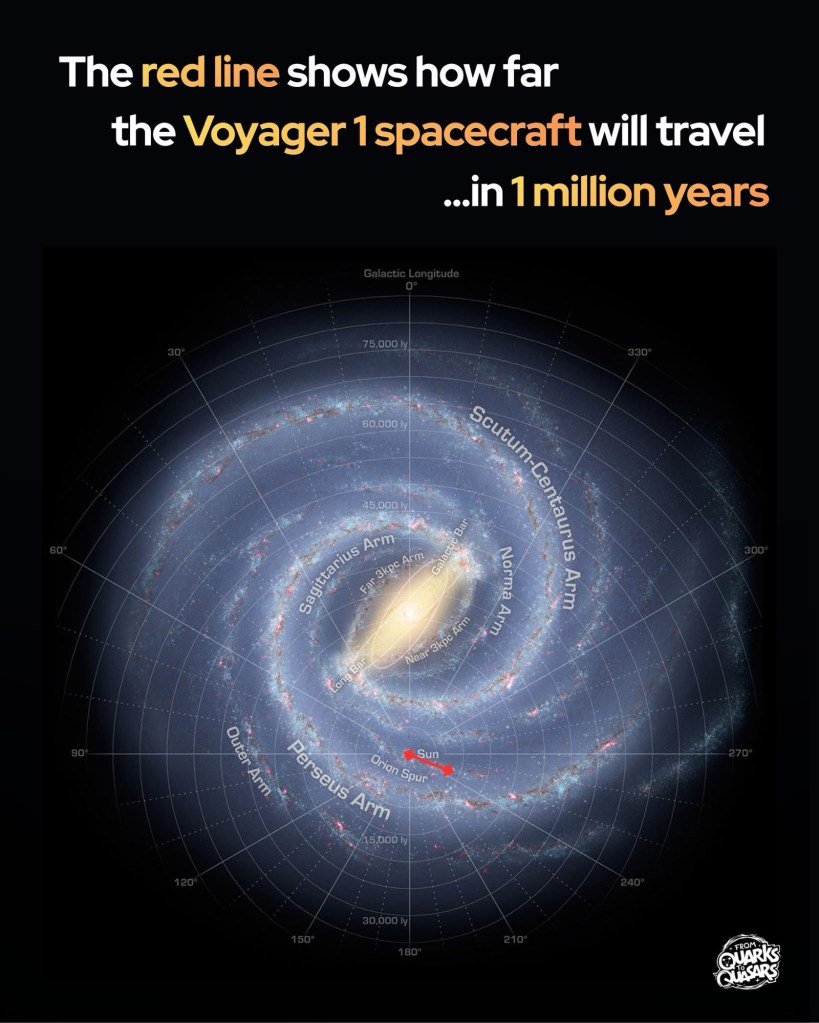
Voyager 1 will travel this far in 1 million years — let that sink in.
Voyager 1 is the furthest human made object in existence and it is currently screaming through the void at 38,000 miles per hour (61,155 kilometers per hour).
Launched in 1977, the spacecraft has already crossed the heliopause, the boundary where the sun’s solar wind meets the interstellar medium. It is now more than 15 billion miles (24 billion kilometers) away from Earth. To put that in perspective, a radio signal traveling at the speed of light takes over 22 hours to reach us from the craft. While it seems like Voyager has traveled an impossible distance, it has barely scratched the surface of the cosmos. In about 300 years, it will reach the inner edge of the Oort Cloud, a vast shell of icy objects surrounding our solar system. It will take another 30,000 years just to fly out the other side.
The red line on a galactic map representing Voyager’s path over the next 1 million years is surprisingly short. Even at its incredible speed, space is so vast that the craft remains a slow mover on a cosmic scale. In about 40,000 years, Voyager 1 will pass within 1.6 light years (9.4 trillion miles or 15 trillion kilometers) of the star AC plus 79 3888 in the constellation Camelopardalis. After that, it will continue to drift through the Milky Way for millions, perhaps billions, of years. Because the vacuum of interstellar space is so empty, the chances of Voyager hitting an asteroid or a planet are nearly zero. It is effectively immortal, destined to outlast the very civilization that built it.
Inside the craft sits the Golden Record, a copper phonograph record containing sounds and images selected to portray the diversity of life and culture on Earth. It is a message in a bottle cast into the cosmic ocean. Even when its plutonium power source finally dies in the coming years, silencing its instruments forever, the craft will remain a silent monument to human curiosity. We are a species that dared to reach into the dark, leaving a permanent mark on the galaxy that will endure long after our own sun begins its final transformation.
 Loren Berg's Blog