










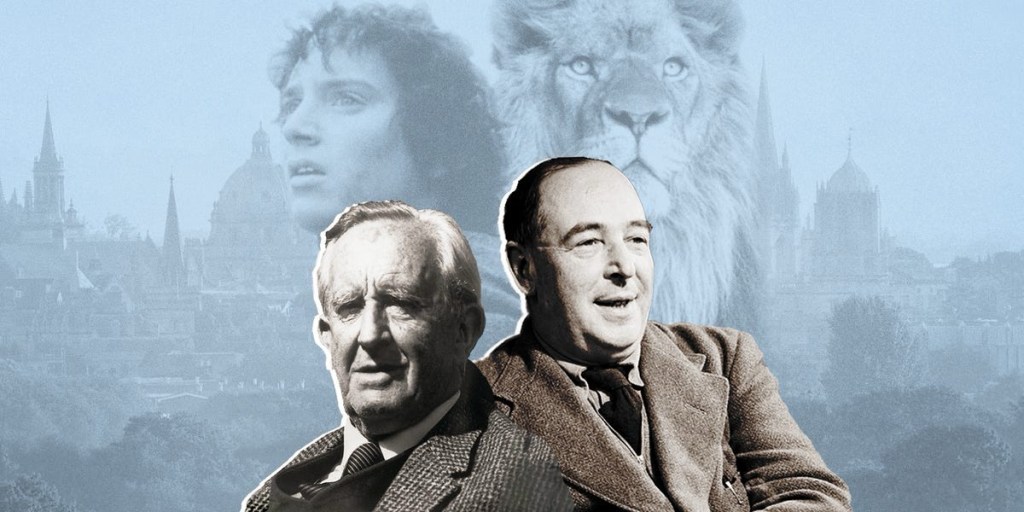
Here are 18 quotes from C.S. Lewis’ letters, essays, and literary works, covering a range of subjects from reading and writing to the importance of friendship. A little more on C.S. Lewis is at the end of this post.
Some day you will be old enough to start reading fairy tales again.
I wrote the books I should have liked to read if only I could have got them. That’s always been my reason for writing. People won’t write the books I want, so I have to do it for myself.
The typical expression of opening Friendship would be something like, “What? You too? I thought I was the only one.”
The task of the modern educator is not to cut down jungles but to irrigate deserts.
A children’s story which is enjoyed only by children is a bad children’s story. The good ones last. A waltz which you can like only when you are waltzing is a bad waltz.
The value of the myth is that it takes all the things we know and restores to them the rich significance which has been hidden by the “veil of familiarity.”
You never know how much you really believe anything until its truth or falsehood becomes a matter of life and death to you.
When I was ten I read fairy tales in secret and would have been ashamed if I had been found doing so. Now that I am fifty I read them openly. When I became a man I put away childish things, including the fear of childishness and the desire to be very grown up.
In reading great literature I become a thousand men and yet remain myself. Like a night sky in the Greek poem, I see with a myriad eyes, but it is still I who see.
No one ever told me that grief felt so like fear.
We all want progress. But … if you are on the wrong road, progress means doing an about-turn and walking back to the right road; and in that case, the man who turns back soonest is the most progressive man.
I do not think the forest would be so bright, nor the water so warm, nor love so sweet, if there were no danger in the lakes.
We have trained [people] to think of the Future as a promised land which favoured heroes attain — not as something which everyone reaches at the rate of sixty minutes an hour, whatever he does, whoever he is.
The books or the music in which we thought the beauty was located will betray us if we trust to them; it was not in them, it only came through them … For they are not the thing itself; they are only the scent of a flower we have not found, the echo of a tune we have not heard, news from a country we have never visited.
Everyone thinks forgiveness is a lovely idea, until they have something to forgive.
For me, reason is the natural organ of truth; but imagination is the organ of meaning. Imagination, producing new metaphors or revivifying old, is not the cause of truth, but its condition.
You can’t get a cup of tea large enough or a book long enough to suit me.
Friendship is the greatest of worldly goods. Certainly to me it is the chief happiness of life. If I had to give a piece of advice to a young man about a place to live, I think I should say, “sacrifice almost everything to live where you can be near your friends.”
Clive Staples Lewis was born in Belfast, Ireland, in 1898 to a family of avid readers. Lewis, too, was soon immersed in literature: He started reading at just 3 years old, and by age 5, he had begun writing stories about a fantasy land populated by “dressed animals.”
Years later, a 19-year-old Lewis served in World War I with the Somerset Light Infantry. He experienced trench warfare on the front line in the Somme, the horrors of which he carried with him for the rest of his life.
Lewis first met J.R.R. Tolkien in 1926, and the two men developed a lifelong friendship. Lewis, who had become an atheist early in life, found his way back to theism and Christianity under Tolkien’s guidance. Tolkien, meanwhile, openly credited Lewis as a major source of creative encouragement: “Only from him,” wrote Tolkien, “did I ever get the idea that my ‘stuff’ could be more than a private hobby. But for his interest and unceasing eagerness for more I should never have brought The Lord of the Rings to a conclusion.”
Lewis himself was a prolific writer of both fiction and nonfiction. The latter included books and essays of Christian apologetics in which he passionately promotes and defends Christianity. Christian themes are also highly prevalent in his works of popular fiction, which include The Screwtape Letters, The Space Trilogy, and, most famously, The Chronicles of Narnia.

Over the years, the typical menu aboard a Pan Am flight was a reflection of luxury and international flair.
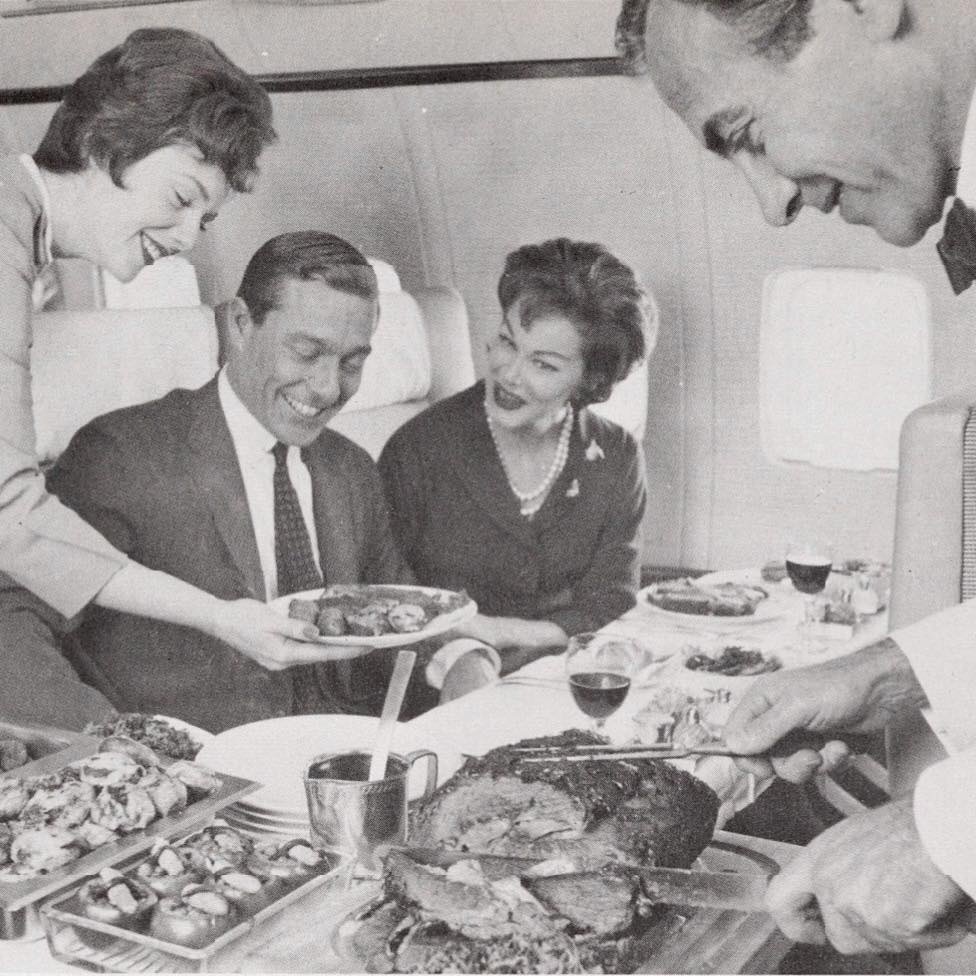
Wealthy Americans’ mid-century interest in luxury and gourmet dining (a selling point was that the famous Parisian restaurant, Maxim’s, allegedly supervised the preparation of meals) was on full display in the multi course menus that greeted first class passengers, down to the Maxim’s logo that decorated the printed menus.
Smartly outfitted chefs and stewards carved meats aisle-side under the gaze of sophisticated passengers, but to keep consistent standards, much of the preparation needed to be centralized.
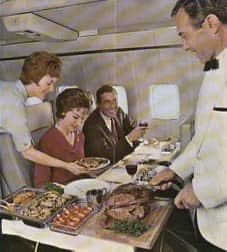
Pan Am’s solution was to develop four gigantic commissaries–in New York, San Francisco, and Tokyo, which would prepare foods, flash Y freeze them, and deliver them to airports around the world. What this meant practically was that items sourced in France, such as foie gras, might be shipped to New York for including in first-class meals, then shipped back to Paris to be loaded on a plane destined New York.
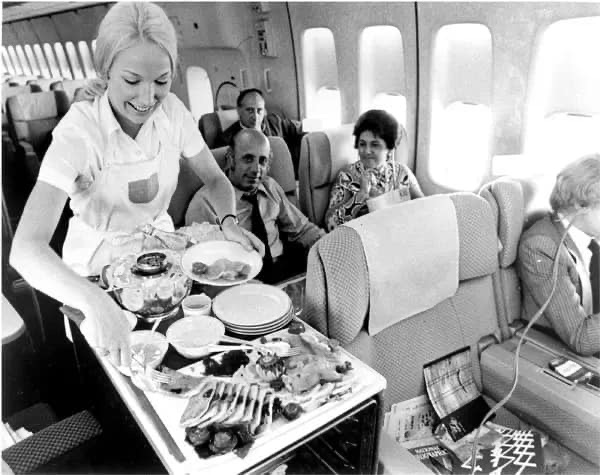
The logistics (and food miles, in these pre-environmentally-conscious days) were astounding.
In the 1950s and 1960s, passengers could expect elaborate meals with multiple courses, such as caviar, lobster, and chateaubriand, served on fine china with silver cutlery.
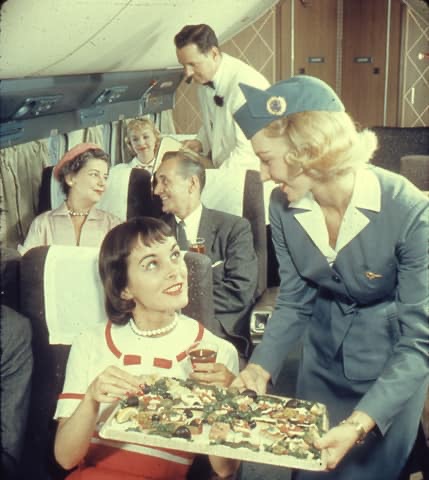
By the 1970s, the menus had become more diverse, incorporating dishes from around the world to cater to an increasingly international clientele.
Despite the changes and deregulation in air travel, Pan Am maintained a reputation for its gourmet cuisine until its operations ceased in 1991.







 You are in the middle of a few projects at your home: putting in a new fence, painting the basement walls and putting in a new garden. You are hot and sweaty, covered in dust, lawn clippings, dirt and paint. You have your old work clothes on. You know the outfit — shorts with the hole in the crotch, old T-shirt with a stain from who-knows-what, and an old pair of tennis shoes.Right in the middle of these projects you realize you need to run to Home Depot for supplies.Depending on your age you might do the following:
In your 20s:
Stop what you are doing. Shave, take a shower, blow dry your hair, brush your teeth, floss and put on clean clothes. Check yourself in the mirror and flex. Add a dab of your favorite cologne because, you never know, you just might meet some hot chick while standing in the checkout line.And yes, you went to school with the pretty girl running the register.
In your 30s:
Stop what you are doing, put on clean shorts and shirt. Change your shoes. You married the hot chick so no need for much else.Wash your hands and comb your hair. Check yourself in the mirror. Still got it. Add a shot of your favorite cologne to cover the smell. The cute girl running the register is the kid sister to someone you went to school with.
In your 40s:
Stop what you are doing. Put on a sweatshirt that is long enough to cover the hole in the crotch of your shorts.Put on different shoes and a hat. Wash your hands. Your bottle of Brute is almost empty; so don’t waste any of it on a trip to Home Depot.Check yourself in the mirror and do more sucking in than flexing.The hot young thing running the register is your daughter’s age and you feel weird about thinking she’s spicy.
In your 50s:
Stop what you are doing. Put on a hat. Wipe the dirt off your hands onto your shirt. Change shoes because you don’t want to get dog crap in your new sports car. Check yourself in the mirror and swear not to wear that shirt anymore because it makes you look fat.The cutie running the register smiles when she sees you coming and you think you still have it. Then you remember — the hat you have on is from Bubba’s Bait & Beer Bar and it says, ‘I Got Worms ‘
In your 60s:
Stop what you are doing. No need for a hat any more. Hose the dog crap off your shoes. The mirror was shattered when you were in your 50s. You hope you have underwear on so nothing hangs out the hole in your pants.The girl running the register may be cute but you don’t have your glasses on, so you’re not sure.
In your 70s:
Stop what you are doing. Wait to go to Home Depot until the drug store has your prescriptions ready too. Don’t even notice the dog crap on your shoes.The young thing at the register stares at you and you realize your balls are hanging out the hole in your crotch.
In your 80s:
Stop what you are doing. Start again. Then stop again. Now you remember you need to go to Home Depot. Go to Wal-Mart instead. You went to school with the old lady greeter.You wander around trying to remember what you are looking for. Then you fart out loud and think someone called your name.
In your 90s & beyond:
What’s a home deep hoe? Something for my garden? Where am I? Who am I? Why am I reading this? Did I send it? Did you? Who farted?
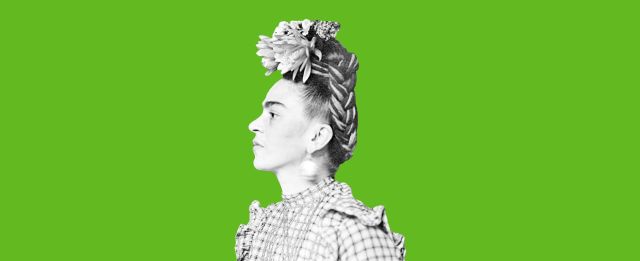
I would like to begin this august assemblage of quotes on change with my long-held belief about change.
Change is neither good nor bad, it is inevitable.
Observe always that everything is the result of a change, and get used to thinking that there is nothing Nature loves so well as to change existing forms and to make new ones like them.
Marcus Aurelius
Change alone is eternal, perpetual, immortal.
Arthur Schopenhauer, philosopher
The art of progress is to preserve order amid change and to preserve change amid order.
Alfred North Whitehead, mathematician and philosopher
To exist is to change, to change is to mature, to mature is to go on creating oneself endlessly.
Henri Bergson, philosopher
There is nothing wrong in change, if it is in the right direction. To improve is to change, so to be perfect is to have changed often.
Winston Churchill
I wanted to change the world. But I have found that the only thing one can be sure of changing is oneself.
Aldous Huxley
To keep our faces toward change and behave like free spirits in the presence of fate is strength undefeatable.
Helen Keller
It’s not about standing still and becoming safe. If anybody wants to keep creating, they have to be about change.
Miles Davis
Change is the law of life. And those who look only to the past or the present are certain to miss the future.
John F. Kennedy
Nothing is absolute. Everything changes, everything moves, everything revolves, everything flies and goes away.
Frida Kahlo
They always say time changes things, but you actually have to change them yourself.
Andy Warhol
All that you touch you change. All that you change changes you. The only lasting truth is change.
Octavia E. Butler
Change almost never fails because it’s too early. It almost always fails because it’s too late.
Seth Godin
If you don’t like something, change it. If you can’t change it, change your attitude.
Maya Angelou
Change will not come if we wait for some other person or if we wait for some other time. We are the ones we’ve been waiting for. We are the change that we seek.
Barack Obama
Some changes look negative on the surface but you will soon realize that space is being created in your life for something new to emerge.
Eckhart Tolle
One child, one teacher, one book, and one pen can change the world.
Malala Yousafzai
Change is made of choices, and choices are made of character.
Amanda Gorman




























 Loren Berg's Blog