




I know I have the body but of a weak, feeble woman; but I have the heart and stomach of a king, and of a king of England too, and think foul scorn that Parma or Spain, or any prince of Europe, should dare to invade the borders of my realm.
Queen Elizabeth I
I hold the sun to be situated motionless in the center of the revolution of the celestial orbs while the earth rotates on its axis and revolves about the sun.
Galileo Galilei
That from these honored dead we take increased devotion to that cause for which they gave the last full measure of devotion — that we here highly resolve that these dead shall not have died in vain — that this nation, under God, shall have a new birth of freedom — and that government of the people, by the people, for the people, shall not perish from the earth.
Abraham Lincoln
I come to ask you to help to win this fight. If we win it, this hardest of all fights, then, to be sure, in the future it is going to be made easier for women all over the world to win their fight when their time comes.
Emmeline Pankhurst
We shall go on to the end, we shall fight in France, we shall fight on the seas and oceans, we shall fight with growing confidence and growing strength in the air, we shall defend our Island, whatever the cost may be, we shall fight on the beaches, we shall fight on the landing grounds, we shall fight in the fields and in the streets, we shall fight in the hills; we shall never surrender.
We choose to go to the moon. We choose to go to the moon in this decade and do the other things, not because they are easy, but because they are hard.
I have a dream that one day this nation will rise up and live out the true meaning of its creed: We hold these truths to be self-evident, that all men are created equal.
I have cherished the ideal of a democratic and free society in which all persons will live together in harmony and with equal opportunities. It is an ideal which I hope to live for and to see realized. But, my lord, if needs be, it is an ideal for which I am prepared to die.

Sometimes, when I look at my children, I say to myself, ‘Lillian, you should have remained a virgin.’
– Lillian Carter (mother of Jimmy Carter)
<><>
I had a rose named after me and I was very flattered. But I was not pleased to read the description in the catalogue: – ‘No good in a bed, but fine against a wall.’
– Eleanor Roosevelt
<><>
Last week, I stated this woman was the ugliest woman I had ever seen. I have since been visited by her sister, and now wish to withdraw that statement.
– Mark Twain
<><>
The secret of a good sermon is to have a good beginning and a good ending; and to have the two as close together as possible.
– George Burns
<><>
Santa Claus has the right idea. Visit people only once a year.
– Victor Borge
<><>
Be careful about reading health books. You may die of a misprint.
– Mark Twain
<><>
By all means, marry. If you get a good wife, you’ll become happy; if you get a bad one,you’ll become a philosopher.
– Socrates
<><>
I was married by a judge. I should have asked for a jury.
– Groucho Marx
<><>
My wife has a slight impediment in her speech. Every now and then she stops to breathe.
– Jimmy Durante
<><>
I have never hated a man enough to give his diamonds back.
– Zsa Zsa Gabor
<><>
Only Irish coffee provides in a single glass all four essential food groups: alcohol, caffeine, sugar and fat.
– Alex Levine
<><>
My luck is so bad that if I bought a cemetery, people would stop dying.
– Rodney Dangerfield
<><>
Money can’t buy you happiness. But it does bring you a more pleasant form of misery.
– Spike Milligan
<><>
Until I was thirteen, I thought my name was: ‘SHUT UP.’
– Joe Namath
<><>
I don’t feel old. I don’t feel anything until noon. Then it’s time for my nap.
– Bob Hope
<><>
I never drink water because of the disgusting things that fish do in it.
– W. C. Fields
<><>
We could certainly slow the aging process down if it had to work its way through Congress.
– Will Rogers
<><>
Don’t worry about avoiding temptation. As you grow older, it will avoid you.
– Winston Churchill
<><>
Maybe it’s true that life begins at fifty, but everything else starts to wear out, fall out, or spread out.
– Phyllis Diller
<><>
By the time a man is wise enough to watch his step, he’s too old to go anywhere.
– Billy Crystal
And the cardiologist’s diet: if it tastes good spit it out.
~~~~~~~~~~~~~~~~~~~~~~~~
May your troubles be less, may your blessings be more, and may nothing but happiness come through your door.
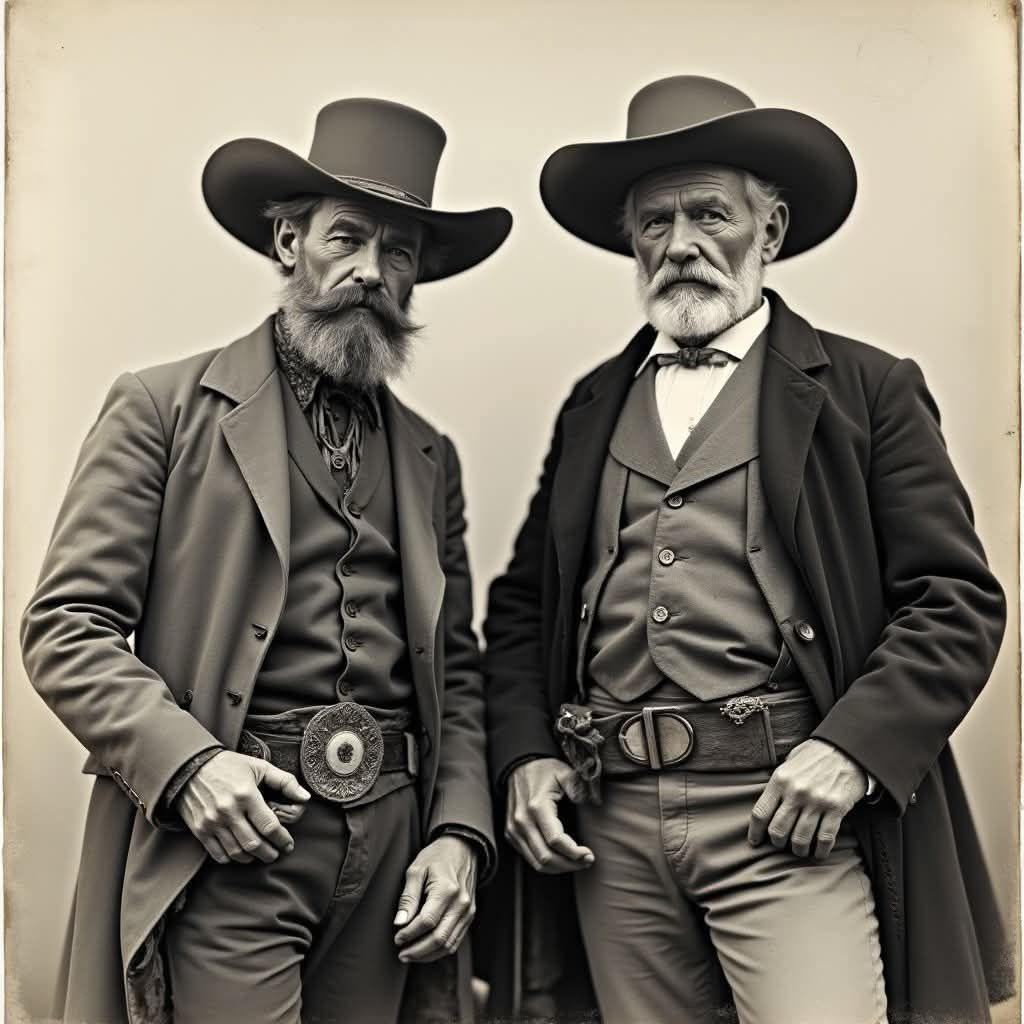
In 1873, two of the most legendary figures of the American Old West, James Butler “Wild Bill” Hickok and William F. “Buffalo Bill” Cody, were captured in a historic moment that epitomized the spirit of the frontier. Both men, renowned for their skills and larger-than-life personas, were celebrated for their contributions to the rugged, untamed history of the American West.
Wild Bill Hickok, famed for his sharpshooting and daring exploits, was a lawman and gunfighter whose name became synonymous with frontier justice. His calm demeanor and steady hand with a revolver earned him a reputation that outshone even the most feared outlaws of his time.
Buffalo Bill Cody, on the other hand, became the embodiment of the Wild West through his incredible achievements as a scout, bison hunter, and showman. His famous Wild West Show brought the mythos of the frontier to audiences across the nation, solidifying his place in American folklore.
Captured together in this iconic image, the two men represent the complex blend of history, myth, and entertainment that defined the American West. Their legacy continues to shape the stories told about this era of American expansion and adventure.


The Viking colonization of Greenland began around 985 CE, led by Erik the Red, a Norseman exiled from Iceland for manslaughter. With few options left in Scandinavia, Erik set sail westward with a small fleet and discovered a vast, icy land. To attract settlers, he famously named it “Greenland,” hoping the appealing name would make it seem more hospitable than it really was.
Erik returned to Iceland and convinced hundreds to join him. About 25 ships set out, though only 14 completed the treacherous journey. The settlers established two main colonies: the Eastern Settlement (near modern-day Qaqortoq) and the Western Settlement (near Nuuk). At its peak, the population may have reached 3,000 to 5,000 people.
The Norse brought cattle, sheep, goats, and iron tools, and adapted their farming techniques to the harsh conditions. They built turf houses, established a Catholic diocese, and even traded walrus ivory with Europe. Though they were isolated, archaeological evidence shows they maintained contact with Iceland and Norway for several centuries.
However, the colonies eventually declined and disappeared by the 15th century. The reasons are still debated but likely include a combination of climate change (the onset of the Little Ice Age), soil erosion, declining trade, and increasing conflict with the Inuit, who had also migrated into Greenland.
By the time Europeans returned to Greenland in the 16th century, the Norse settlers were gone. Their fate remains partly mysterious, but their initial journey stands as one of the earliest examples of transatlantic colonization—nearly 500 years before Columbus.



Legends and Loyalty: Calamity Jane at Wild Bill’s Grave — Deadwood, ca. 1903 In a rare and evocative photograph taken around 1903, Calamity Jane—frontierswoman, scout, and Wild West icon—is seen posing solemnly at the grave of Wild Bill Hickok in Deadwood, South Dakota. The image captures a woman whose life was as rugged and unorthodox as the land she called home. Though much of her legacy is wrapped in legend, this moment is real: a deeply personal gesture of loyalty to the man she revered—and possibly loved. Wild Bill was shot in the back while playing poker in Deadwood in 1876, holding what became known as the “Dead Man’s Hand.” Calamity Jane, known for her tough-as-nails persona and hard-drinking, wild-living ways, claimed to have had a close relationship with him—though historians still debate the nature of it. What is certain is that when she died in 1903, per her request, she was buried next to Wild Bill, a testament to the enduring mythos that bound their names forever in American folklore. This photograph isn’t just a portrait—it’s a snapshot of the end of an era. The fading Old West, captured in the weathered face of a woman who lived it, mourned it, and became one of its last living links